
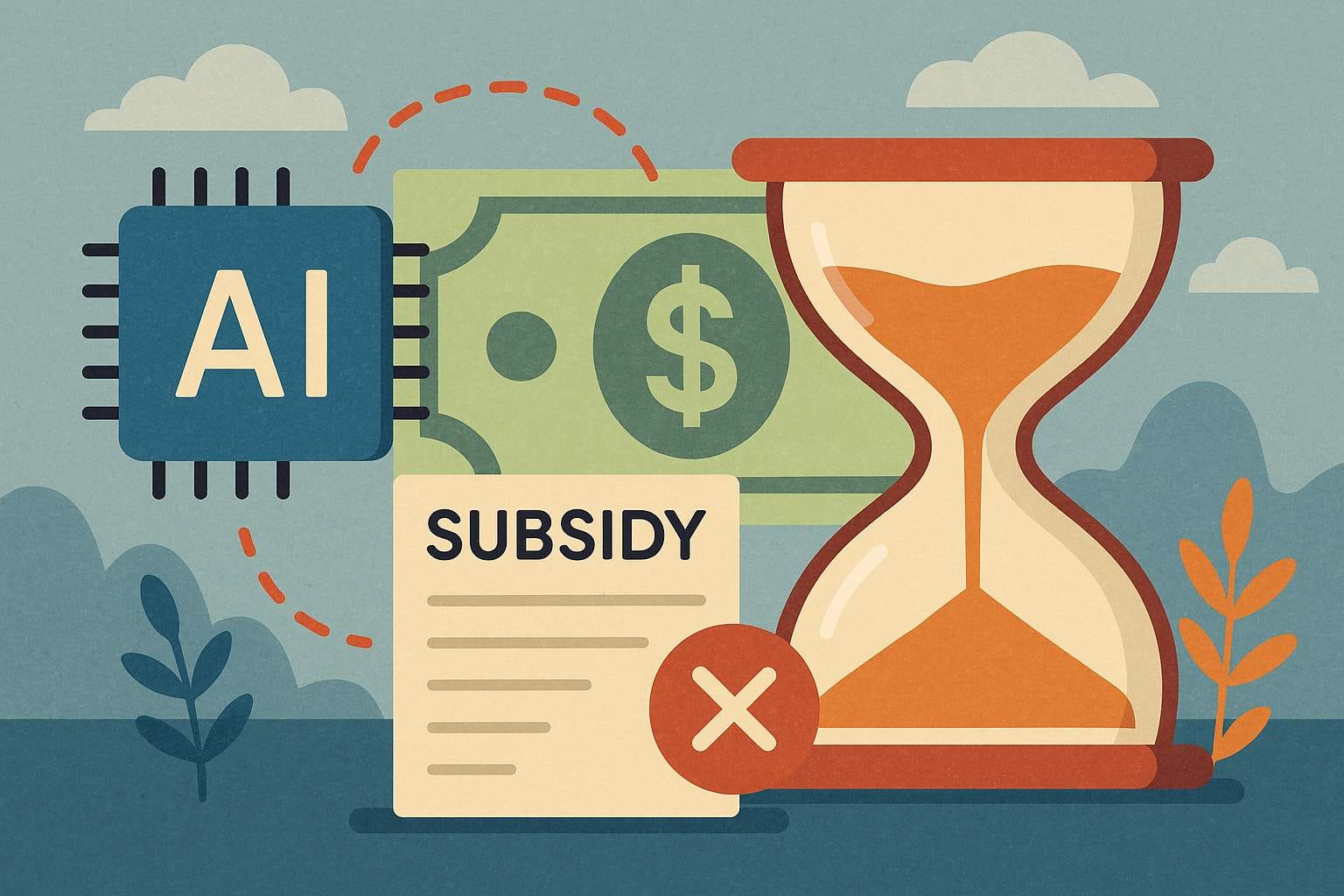
Runtime Intelligence Is a Subsidy. Subsidies Expire.
Every inference call is a rent payment. Most AI architectures are built on a lease that gets more expensive every quarter.

The Wrong Mental Model
The most dangerous assumption in technology is the one you stopped noticing because it was true for twenty years.
Compute is cheap. Storage is abundant. Scale is a slider you push to the right. The cloud turned physical infrastructure into an abstraction so durable that it became instinct. Engineers stopped thinking about marginal cost. Product managers stopped asking what a feature costs to run. Finance teams stopped modeling usage as a liability. The entire software industry built its intuitions inside a world where the marginal cost of one more request approached zero. Those intuitions calcified into the default mental model for everything that came after.
AI arrived inside that mental model and the mismatch has been invisible ever since.
Here is the dominant wrong interpretation, and it is worth naming early: AI is the next cloud. Costs will fall. Infrastructure will amortize. The economics will eventually converge. This is the story most leaders are telling themselves, and it is structurally incorrect. Not because the costs will not fall, some will, but because AI runs on fundamentally different physics than cloud compute, and the companies that apply cloud-era intuitions to AI-era economics are building toward a specific, avoidable failure.
The cloud abstracted hardware. AI exposes it. A GPU is not an elastic resource. It is a physical machine with a fixed thermal envelope, a fixed memory footprint, and a depreciation curve measured in quarters rather than years. Every inference burns power. Every token is a transaction. Every context window has a ceiling set by silicon, not by product decisions. When Nvidia releases a new architecture, the economics of every data center running the previous generation reset overnight. The cloud could defer these realities behind abstraction layers. AI cannot. The meter is visible because it cannot be hidden.
OpenAI rate-limits free users at peak hours. Anthropic charges a premium for extended context windows. Google quietly adjusts quotas on Gemini. Perplexity throttles high-volume users. These are not product decisions. They are expressions of physical constraint. The arcade owner is adjusting the price of tokens because the electricity bill is real and rising.
The wrong mental model produces predictable errors. Companies launch AI features that cost more to run than they generate in value. They build agentic workflows that multiply inference calls in the name of autonomy. They create architectures where fixing a bug requires calling the model again, and again, and again. They mistake capability for economics. They assume that because the demo worked, the unit economics will follow. They do not.
The cloud era ended when intelligence became expensive. The instincts it produced are now liabilities.
The Physics of Rented Intelligence
Cloud computing has one economic property that made the last twenty years possible: the marginal cost of serving one more request approaches zero. Once the servers are running, an additional API call costs almost nothing. This is why cloud businesses scale. It is why free tiers are viable. It is why entire industries were built on the assumption that infrastructure is an abstraction and compute is functionally free.
AI has the opposite property.
Every inference has a real, positive, non-declining marginal cost. The cost is measured in watts, in memory bandwidth, in the number of H100s a provider can physically acquire and keep running. It does not approach zero as usage scales. It rises. This is not a transitional state that will resolve as the technology matures. It is a structural property of the substrate. Matrix multiplication on scarce silicon at scale does not get cheaper the more you do it. It competes with every other user doing the same thing on the same hardware.
The numbers make this concrete. Hyperscaler capital expenditure reached $251 billion in 2024, a 62% increase from the prior year. Analysts project $400 billion in 2025 and $600 billion in 2026. This capital is not being deployed because the economics are proven. It is being deployed because the supply chain requires commitments years in advance, and no hyperscaler can afford to lose GPU allocation to a competitor who will not pause. Microsoft spent $34.9 billion in a single quarter of 2024, a 74% year-over-year increase. Alphabet revised its 2025 capex forecast upward three times within a single fiscal year, ending at $91-93 billion against $52.5 billion the prior year. These are not investments in abundance. They are the cost of staying inside a system where the alternative to spending is irrelevance.
The inference tax compounds at the application layer. A single user session with a capable reasoning model can cost orders of magnitude more than an equivalent cloud API call. A multi-agent workflow that calls a model at each decision point multiplies that cost by the number of agents and the length of the task. A system that uses AI for runtime logic rather than design-time generation pays the inference tax on every user interaction, every day, indefinitely. The cost does not amortize. It accrues.
GPUs are the jet engines of this era. Inference is the fuel. Context windows are the cabin size. Model quality is the safety rating. Pricing tiers are the route economics. And just like aviation, you cannot win by operating bad planes at high fuel prices. You can only win by flying fewer, more efficient routes. Or by changing the aircraft entirely.
The companies that understand this are already behaving differently. Apple’s on-device intelligence push, announced at WWDC 2024 and shipped through the fall, is not a privacy story. It is an economics story. Local inference has zero marginal cost at the application layer. Every query handled on-device is a query that does not burn cloud inference budget. Meta’s decision to open-source Llama 3 in April 2024 is not a philosophy story. Running your own weights costs a fixed capital expense that amortizes. Renting inference pays a variable cost that does not. The companies moving toward owned intelligence are not making ideological choices. They are responding to physics.
Intelligence rented per token is a cost center. Intelligence distilled into owned systems is infrastructure.
The Vibe-Coding Cliff
There is a specific moment every engineering team reaches when AI-assisted development stops feeling like leverage and starts feeling like debt. It does not arrive dramatically. It arrives as a series of small, individually reasonable decisions that compound into a structural problem nobody planned for.
The model rewrites a function that already existed. A refactor breaks an invariant that was never supposed to move. A boundary that held for six months dissolves in a single inference. Nothing crashes. Nothing alerts. The system still compiles. The dashboards are still green. But the architecture has drifted, and the drift is invisible until it is expensive.
This is vibe-coding’s cliff. The terrain looks flat until you step off it.
The failure is not in the models. Cognition’s Devin, launched in March 2024 as the first fully autonomous software engineer, completed three of twenty real-world tasks in Answer.AI’s independent testing published in January 2025. The SWE-bench success rate was 13.86%. The failures were not errors in the conventional sense. They were drift: the model pursuing architecturally incompatible solutions for days, completing work that was adjacent to what was requested but not identical, operating without any mechanism to detect when its outputs had drifted from the system’s actual constraints. GitHub Copilot Workspace shows the same failure mode at scale. Impressive on isolated tasks. Brittle the moment the work requires coherence across the full system.
The industry’s response has been to add more scaffolding. LangChain in October 2022 promised to solve agent coordination through layered orchestration. AutoGPT in March 2023 promised autonomous task completion. CrewAI in late 2023 promised multi-agent collaboration. Each framework added abstraction on top of the same stateless substrate. Each collapsed under production load for the same structural reason: they multiplied the surfaces of drift without providing any mechanism to detect or prevent it. More agents means more inference calls means more cost means more drift means more failures means more agents to compensate.
The loop is self-reinforcing and expensive in both senses.
I built a production platform over eight to ten months: 300,000 lines of code, dozens of microservices, event-driven architecture, GDPR compliance, Terraform-managed infrastructure, 2,256 automated tests with 15,998 assertions. The system held together not because the models were exceptional but because I built an explicit memory layer around them. Living architecture documents. Invariant catalogues. Surgical-change rules that prevented the model from touching anything outside the defined scope. Mandatory context reconstruction at the start of every session. Contradiction-escalation gates that stopped the model from guessing when requirements conflicted. Without that structure, the models reliably drifted. With it, they executed with precision.
The constraint was not the model. The constraint was always the substrate.
Vibe-coding is not a development style. It is the inevitable failure mode of stateless prediction applied to stateful systems. It cannot be debugged. It cannot be prompted away. It cannot be fixed by adding more agents or longer context windows. The physics that produce it are the same physics that make the model useful in the first place. You cannot have the prediction without the forgetting.
It can only be replaced.
The Compiler Moment
Every major computing shift follows the same arc. First, raw capability is applied directly. Then chaos accumulates. Then the realization: capability alone is not enough. The missing piece is always the same: a layer that transforms capability into something deterministic, durable, and safe to build on. A layer that does not execute intelligence. A layer that distills it.
This is the compiler moment. And AI is standing at its threshold now.
The analogy is precise, not decorative. A compiler does not execute your program. It transforms intent into deterministic structure that runs without the compiler’s continued involvement. You write logic once. The compiler processes it once. The output runs indefinitely without burning compute on every iteration. The intelligence is front-loaded. The execution is free.
The current AI paradigm is the opposite. Intelligence is applied at runtime, on every request, continuously rented from a provider who charges per token. This is not a software model. It is a utility model. And utility models have fundamentally different economics than software: the cost scales with usage rather than amortizing against it, the margin compresses as volume grows rather than expanding, and the dependency on the provider deepens over time rather than decaying.
The shift that is now emerging is from AI as a runtime dependency to AI as a design-time engine. From model as oracle to model as compiler. From intelligence rented per inference to intelligence distilled into owned, deterministic form.
You can see this transition happening in the decisions of the companies that understand the economics earliest. Palantir’s AIP, which reached $255 million in US commercial revenue in Q3 2024, is not a chatbot. It is a system that uses AI to generate ontological structure and workflow logic that then executes deterministically inside enterprise environments. The model runs at design time. The output runs at zero marginal cost. Cursor, which crossed $100 million ARR in August 2024 and $500 million ARR by early 2025, built its architecture around the insight that the most valuable AI assistance is the kind that produces code you own, not suggestions you rent. The model generates structure. The structure persists. Apple’s Neural Engine processes 15.8 trillion operations per second in the M4 chip, not because Apple is racing benchmarks, but because local inference eliminates the per-token cost entirely. The intelligence is compiled into the device. The execution is free at the margin.
The named mechanism here is The Distillation Shift: intelligence applied once at design time to generate deterministic structure is infrastructure. Intelligence applied continuously at runtime to substitute for missing structure is a cost center. The distinction is not philosophical. It is the difference between a compiler and an interpreter, scaled to the economics of AI.
Design-time intelligence is not one viable approach among several. It is the only economically stable equilibrium. Runtime intelligence is a subsidy: someone is paying the inference tax on every interaction, and at scale that someone is either the provider absorbing losses or the customer absorbing prices that compress every margin in the stack. The subsidy can persist for years. It cannot persist indefinitely. Every technology that began as a metered utility either found a way to amortize its core cost or was replaced by something that did. AI will follow the same arc. The question is not whether design-time intelligence wins. It is who builds the infrastructure that makes it systematic.
The companies that make this shift will not look like they are doing something different at the surface. Their products will feel similar. Their models will be comparable. But their cost structures will diverge rapidly. The runtime-dependent company pays the inference tax on every user interaction indefinitely. The design-time company pays once and amortizes. Over two years, at meaningful scale, the difference is not marginal. It is existential.
The model is not the system. The model is the tool that produces the system.
The Infrastructure That Owns the Next Era
Every technological era centralizes around the layer that controls the scarce resource. In the railroad era, the scarce resource was right-of-way. The companies that owned the routes owned the economy. In the oil era, it was refining capacity. Standard Oil did not control oil in the ground. It controlled the infrastructure that turned crude into something usable. In the PC era, it was the operating system. Microsoft did not manufacture computers. It owned the layer that everything else depended on. In the cloud era, it was elastic compute. AWS did not invent the internet. It built the abstraction that made the internet programmable.
In the AI era, the scarce resource is not the model. Models are commoditizing faster than any prior technology layer. GPT-4, released in March 2023, was a frontier capability. Within eighteen months, open-source models were running comparable tasks on consumer hardware. DeepSeek replicated frontier-grade performance in early 2025 for a reported $5 million in compute, against the hundreds of millions spent by US frontier labs. The model is not the moat. The model is the commodity.
The scarce resource is coherence. The ability to maintain architectural identity across time, across autonomous agents, across the inference boundaries that stateless models cannot cross on their own. The companies that build the substrate for coherence, the architectural memory, the invariant enforcement, the design-time intelligence layer that sits between raw models and reliable production systems, will own the infrastructure position of this era. Not because they have the best weights. Because they have the layer that makes weights useful at scale.
Goldman Sachs projects $1.15 trillion in combined hyperscaler capital expenditure from 2025 through 2027. That capital is funding the capability layer. The substrate layer remains almost entirely unbuilt. The architectural memory, the constraint enforcement, the governed intelligence layer that allows AI to modify systems without dissolving them: that infrastructure does not yet exist as a category. It exists only as manual process in the teams disciplined enough to build it by hand, and as the implicit architecture of a handful of companies that have discovered it through production experience.
The platform opportunity follows the same logic as every prior era. AWS did not win by having better servers than anyone else. It won by owning the abstraction that made servers interchangeable. Stripe did not win by processing payments faster. It won by owning the primitive that made money movement programmable. The architectural memory layer is that primitive for AI engineering. Once it exists, the models above it become interchangeable. The agents become interchangeable. The orchestration frameworks become interchangeable. The only thing that is not interchangeable is the layer that makes coherence possible.
There is one property this layer has that no prior AI component shares: it compounds. Models do not compound. A better model replaces a weaker one; the old one contributes nothing to the new one’s capability. Agents do not compound. An agent that completed a task last month has no structural memory of how it did so. Architectural memory compounds directly. Every decision encoded into the substrate makes the next decision cheaper to validate, faster to enforce, and harder to violate accidentally. The substrate accumulates value the way a codebase accumulates tests: each addition makes the whole system more resistant to the failure modes that preceded it. This is the property that turns a tool into a platform and a platform into infrastructure.
The window between “models are capable enough” and “the substrate platform has already formed” is narrow. It opened sometime in 2024, when the failure modes of runtime-dependent AI became visible at production scale. It will close when one or two companies have accumulated enough architectural memory, enough production deployments, and enough enterprise dependency that the position becomes durable.
The companies that survive the transition from the arcade era to the infrastructure era will share three properties. They will treat intelligence as a design-time resource rather than a runtime dependency. They will own the substrate that makes AI coherent across time rather than renting coherence per inference. And they will build positions in the load-bearing layer before the rest of the market understands which layer is load-bearing.
The rest will be case studies in applying cloud-era intuitions to AI-era physics.
The future is not agents that think. It is systems that remember.
What This Means — For the People Who Have to Decide Now
For engineering leaders and CTOs: every agentic workflow in your stack is a hypothesis about inference economics. The hypothesis is that the value generated per model call exceeds the cost of the call, at your scale, sustainably. Most teams have not run this calculation explicitly. They should. The workflows that fail it are not engineering successes with cost problems. They are architectural mistakes. The correct response is not to negotiate better pricing. It is to redesign the architecture so the model runs at design time rather than runtime. Every decision that can be made once and encoded deterministically is a decision that should never touch a model in production again.
For founders building on AI: the defensible position is not the wrapper around a model. It is the accumulated architectural decisions, domain constraints, and invariants that any serious substrate will need to encode. If you are building a product that calls a model on every user interaction, you are building a cost structure that competes with every other company calling the same model on every user interaction. If you are building a product that uses a model to generate structure that then runs without the model, you are building infrastructure. The difference in exit multiple between these two positions is not incremental. The companies that understand this distinction in 2025 will define their categories. The companies that discover it in 2027 will be acquiring from them.
For investors: the moving frontier in AI is not model capability. Models are commoditizing. The moving frontier is the substrate layer, and it is almost entirely unfunded relative to its strategic importance. The signal is not demo quality. It is production architecture: does the company’s system get cheaper as it scales, or more expensive? Does the intelligence run at design time or runtime? Does the company own its architectural memory, or does it rent coherence per token? The companies that answer these questions correctly before the substrate category consolidates will have infrastructure positions. The companies that answer them afterward will have dependencies.
The structural takeaway: AI runs on fundamentally different economics than cloud compute. The marginal cost of inference does not approach zero. It is real, positive, and bounded by scarce silicon. Hyperscaler capex reached $251 billion in 2024 and is projected at $600 billion by 2026, not because demand is proven but because the supply chain requires commitments in advance. The vibe-coding paradigm compounds this problem: runtime-dependent AI pays the inference tax on every user interaction indefinitely, while Cognition’s Devin, LangChain, AutoGPT, and CrewAI have each demonstrated that stateless models cannot maintain architectural coherence at production scale. The shift that follows is from AI as a runtime oracle to AI as a design-time compiler: intelligence applied once to generate deterministic structure that runs without the model’s continued involvement. Palantir, Cursor, and Apple are already building this way. The substrate layer that makes this shift systematic, the architectural memory and invariant enforcement that sits between raw models and reliable production systems, remains almost entirely unbuilt. The company that builds it will not have the best model. It will have the layer that every model depends on.