
Subscriptions Will Survive in Exactly Two Places
How the Architecture of Extraction Became the Architecture of Everything — and Why It’s Starting to Break

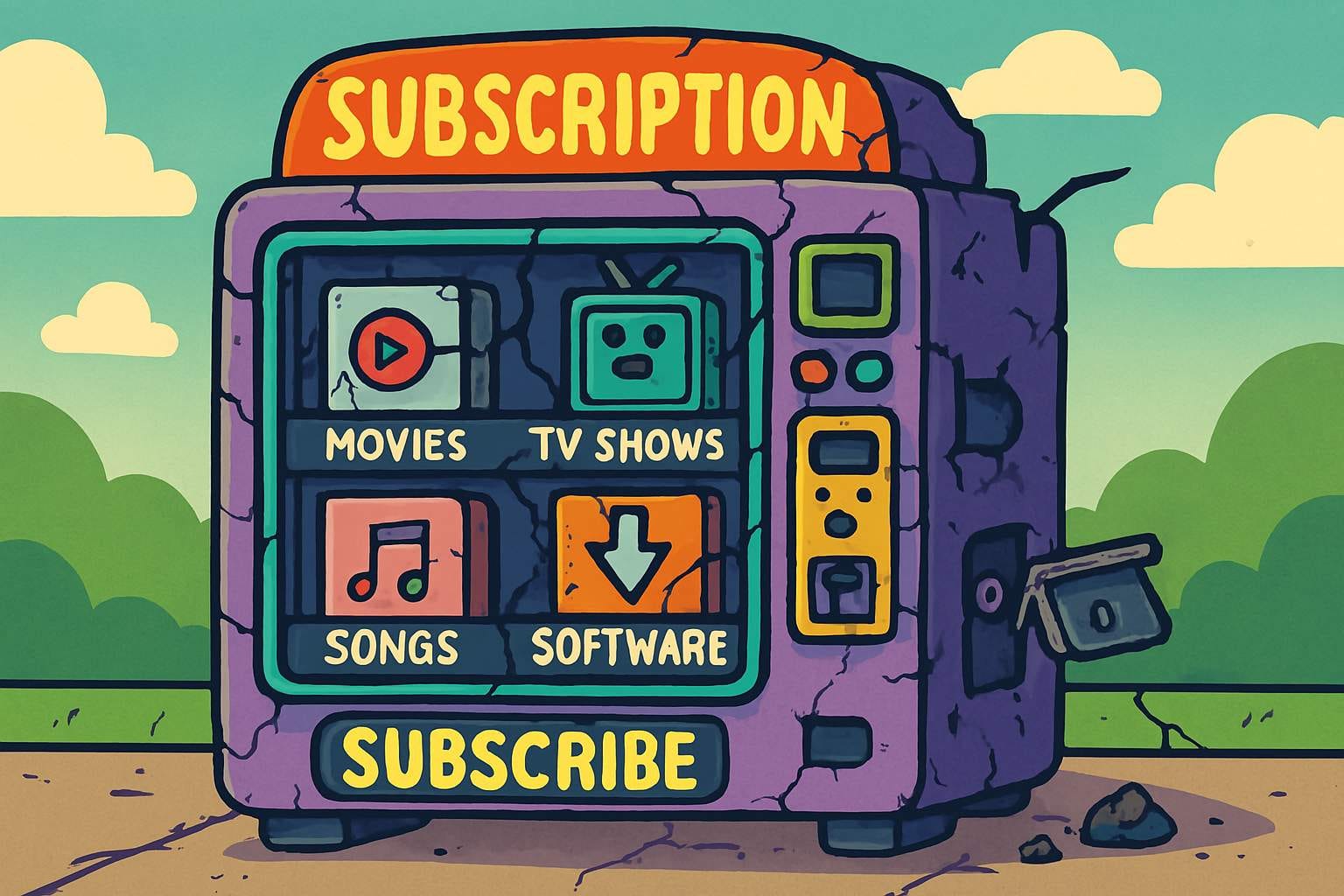
The Hum You Stopped Noticing
There is a particular sound every vending machine makes. A low, mechanical drone — steady, patient, indifferent. It doesn’t start when you walk up. It doesn’t stop when you walk away. It runs whether you buy something or not, whether the machine is full or empty, whether anyone is watching. The hum is not for you. The hum is the machine reminding itself that it exists.
Modern consumer life has started to sound like that. Not dramatically, not all at once — but in the way that background noise becomes invisible only once you’ve been inside it long enough to stop noticing. Every app, every service, every convenience comes attached to a meter running silently in the background. You don’t hear the billing cycle. You don’t feel the renewal. You don’t see the lock-in until the day you try to leave. And then, suddenly, you do.
Here is the structural truth the machine is built on: you don’t need to understand the economics of a system to be shaped by it. The vending machine economy did not require consumers to opt in. It required only that the incentives for building it were strong enough to make every alternative seem irrational. And they were. When Wall Street learned — sometime around 2014, when SaaS ARR multiples stabilized between 6x and 10x revenue and investor appetite for predictable recurring cash flows became the dominant logic of tech valuation — that subscription businesses were worth fundamentally more than transactional ones, the architecture of the entire software industry reorganized itself around that fact. Not because anyone chose extraction over empowerment as a moral preference. Because the math made it inevitable.
This is the essay about how that math works, what it has done to the things we use every day, and why three forces now converging — income shocks, context exhaustion, and AI-enabled category repricing — are breaking it faster than anyone expected.
The Adobe Case Study Every Software Company Copied
In May 2013, Adobe Systems announced it would stop selling perpetual licenses for Creative Suite. No more Photoshop CS7. No more boxed software. No more one-time payment. Going forward, if you wanted Photoshop, Illustrator, or InDesign, you would pay $49.99 a month, every month, forever. The backlash was immediate. A Change.org petition titled “I do not want to subscribe to use Photoshop” collected over 50,000 signatures within weeks. Adobe’s stock dropped 12% in the months following the announcement. The company publicly predicted a $200 million revenue gap as it absorbed the transition. By every short-term metric, it looked like a mistake.
It was not a mistake. It was the blueprint.
By Q3 of 2013 — just four months after the announcement — Adobe had crossed one million paid Creative Cloud subscribers, ahead of schedule. By mid-2014, it had three million. By 2015, subscription revenue had already surpassed what perpetual licensing ever generated. By 2022, ARR had grown from effectively zero at the transition’s start to over $19 billion. Adobe’s stock, which dropped 12% on the news, increased by over 1,200% in the decade that followed. Revenue grew from $4.4 billion in 2013 to $23.7 billion by 2025 — a fivefold increase driven entirely by the predictability of recurring income, not by any corresponding leap in product quality. The software didn’t improve 1,200%. The business model did.
CFO Mark Garrett, presenting to analysts during the painful transition period, said something that became the template for every similar transformation that followed: “Don’t look at the P&L. Look at the number of new subscribers. Look at ARR.” He was telling investors to ignore the measure of current value and focus on the measure of captured future value. It worked so completely that within five years, every software company with ambitions had internalized the same logic. ARR became the North Star. Churn became the existential threat. And the easiest way to minimize churn is not to delight the customer. It is to entangle them — to make the exit painful, the alternatives scarce, and the dependency feel like the natural order of things.
What Adobe proved was not that subscriptions were better for users. It proved that subscriptions were better for multiples. And in a world where companies are valued on ARR, that distinction collapses. The incentive to maximize extraction becomes indistinguishable from the incentive to maximize value. At least until the customer begins to notice the difference.
The Architecture of Dependency
The subscription model is not a pricing strategy. It is a dependency engine — and understanding it as architecture rather than pricing is the only way to see clearly what it has done to the products we use every day.
When the marginal cost of delivering a digital good approaches zero, the rational business decision is not to sell the good. It is to sell perpetual access to the good. Access is recurring. Access is predictable. Access compounds. Ownership ends the relationship. Subscription extends it indefinitely. This is not an observation about corporate ethics. It is an observation about physics. Once Wall Street priced companies on ARR multiples — ranging from 6x to 10x during the stable pre-COVID period, spiking as high as 20-25x for top performers during 2020-2021, compressing back to a median of 5.1x by December 2025 — every software company that wanted capital or liquidity had to optimize for the same metric. Predictability became more valuable than quality. Retention became more important than innovation.
You can see the architecture in concrete product decisions that otherwise make no sense. In July 2022, BMW introduced subscriptions for heated seats in select models — hardware already physically installed in the car, locked behind a software paywall. The backlash was swift enough that BMW reversed the decision in September 2023, with a board member acknowledging that customers “felt they paid double.” Tesla followed, with software revealing in late 2023 that heated front seats and windshield wipers were being converted to paid unlock features for new models. New York State responded in 2025 by passing legislation prohibiting automakers from charging subscription fees for hardware-based features already installed in the vehicle. The machine had expanded into the driver’s seat, and the political system began pushing back.
The Spotify case is more instructive precisely because the backlash never came — which is what made it the model. In 1999, global recorded music revenue peaked at an inflation-adjusted $22.7 billion. By 2014, after a decade of piracy and digital disruption, it had collapsed to $7.3 billion. Spotify offered a solution: legal access to everything, at $9.99 a month. By 2024, it had over 600 million active users and paid out more than $11 billion in royalties in a single year. Industry revenue recovered. Fortune declared, in 2019, that “Spotify saved the music industry.” The numbers support it. But look one layer deeper, and a different picture emerges. The platform pays artists between $0.003 and $0.005 per stream — meaning an artist needs approximately one million streams per month to earn minimum wage from Spotify alone. Warner, Sony, and Universal, who together received an 18% ownership stake in Spotify at the company’s founding, collect approximately $1 million per hour from music streaming. The model rebuilt music industry revenue while fundamentally restructuring who captures it. The machine can create value. It just decides who receives it.
Netflix did the same to film. The DVD shelf disappeared, replaced by a catalog that shifts based on licensing deals invisible to the consumer. Content vanishes without notice. What you watched last month may not exist next month, because it was never yours. You rented the right to browse. The psychological shift is subtle but structurally significant: a generation stopped building libraries and started building watchlists, stopped thinking in terms of ownership and started thinking in terms of access windows. The architecture changed the behavior, and the behavior normalized the architecture.
The Hidden Tax Nobody Calculated
The most revealing data point about the subscription economy is not how much people pay. It is how much they think they pay.
C+R Research surveyed 1,000 US consumers about their subscription spending. When asked to estimate their monthly total offhand, the average answer was $86. When asked to walk through their subscriptions category by category — streaming, software, music, fitness, cloud storage, gaming, news, delivery — the actual figure was $219. A gap of $133 per month, or roughly $1,600 per year. Nearly a third underestimated by $100 to $199. Almost a quarter were off by $200 or more. A separate West Monroe study found that 89% of consumers underestimate their subscription spending, with 66% underestimating by more than $200 monthly. And 42% of consumers, across both studies, admitted they were still paying for at least one subscription they had stopped using entirely.
This gap is not an accident of consumer psychology. It is the designed output of an architecture built to exploit the difference between active decisions and passive billing. The machine charges while you sleep. It renews while you’re distracted. It grows while you’re not watching. And it counts on the fact that auditing your subscriptions requires more friction than simply letting them run. The average American household now spends $219 per month on subscriptions while believing they spend $86. The machine’s most powerful feature is not its product. It is its invisibility.
This invisibility is also the machine’s structural vulnerability. Because the gap between perceived and actual cost is a pressure valve — it holds as long as incomes are stable and attention is elsewhere. The moment either changes, the audit begins. And audits are where subscriptions die.
The Three Forces That Are Breaking the Machine
Every extraction-based system carries within it the seeds of its own reversal. The question is never whether the forces accumulate — they always do. The question is which specific mechanisms trigger the shift. For the subscription economy, three are now converging simultaneously, and understanding each one precisely is what separates a structural prediction from a vague intuition about “fatigue.”
The first force is income elasticity. Subscriptions are uniquely, asymmetrically vulnerable to income shocks — in a way that utility bills are not and that one-time purchases never were. When earnings drop, a life event disrupts routine, or someone simply opens their bank statement and feels the gap between what they thought they were spending and what they are actually spending, subscriptions are the first category on the audit list. Not because they are the most expensive line item, but because they are the most discretionary-feeling while being the most structurally sticky. Nobody cancels electricity when times get tough. People absolutely cancel their fourth streaming service, their unused software suite, and their gaming platform subscription on the same afternoon they do the math.
The data confirms the mechanism. Kantar found that over one million music streaming subscriptions in Great Britain were cancelled in Q1 2022 alone, with 37% of cancellers citing the desire to save money. Reviews.org found that 39% of Americans cancelled at least one streaming service in a six-month period in early 2023, with 44% citing monthly expense reduction as the primary driver. During the same inflation cycle, streaming prices for major platforms rose an average of 25% in 2023 — nearly four times the consumer price index increase for the same period. The machine raised prices at exactly the moment incomes were under pressure. That combination is not sustainable. By 2024, only 13% of consumers said they were willing to spend more than $60 monthly on streaming, down from 17% in 2022. The tolerance ceiling is falling while the price floor rises.
Crucially, subscriptions do not recover after income shocks the way utility consumption does. A household that cancels streaming services during a tight quarter does not automatically resubscribe when the pressure eases. They discover the gap that the subscription was filling was smaller than the monthly fee suggested. The audit, once triggered, tends to stay triggered. This is why churn in the subscription economy is not symmetric with the economic cycle. It spikes on the way down and does not fully recover on the way up.
The second force is context exhaustion. This is the less discussed and more structurally original mechanism. People do not migrate off platforms when the platform gets worse. They migrate when they feel they have extracted the available context — when the library feels depleted, the catalog feels familiar, the tool feels understood. The subscription was implicitly a bounded educational or entertainment experience, and once it felt complete, the monthly fee became indefensible.
The streaming data makes this visible with unusual precision. Churn analytics firm Churnkey found that 26% of video streaming subscribers cancel specifically after finishing the content they came for. Deloitte’s Digital Media Trends report found that 49% of users are willing to cancel a service when they spend too long searching and can’t find something to watch — the moment the library feels exhausted relative to the effort of browsing it. Nearly half of active streaming subscribers claim to sign up specifically to watch something and cancel immediately after finishing it. The platforms have a term for this behavior: serial churners. They represent 23% of the streaming audience. They are not disloyal. They are rational. They are optimizing for context, not access.
The implication is sharper than it first appears. The subscription economy assumed that consumers would value perpetual access to a growing catalog. What consumers actually value is the marginal context they haven’t yet consumed. Once they feel they’ve reached the edge of what a platform offers them specifically, the monthly fee stops being a purchase and starts being a tax. Five streaming platforms, a music service, a gaming subscription, an internet connection, a mobile plan, and three software suites do not feel like abundance when you’ve watched everything you wanted to watch, heard everything you wanted to hear, and learned everything the tools have to teach you. They feel like maintenance fees for a state you’ve already achieved.
This is why the consolidation happening in consumer subscriptions is not just a response to price pressure. It is a response to context saturation. The average American subscribed to 4.1 video streaming services in early 2022. By early 2023, that figure had dropped to roughly two. The reduction was not primarily driven by price increases — it was driven by the realization that marginal platforms contained marginal context. Once the unique content on a platform was consumed, the platform became redundant. The machine’s promise of infinite content turned out to be finite relevance.
The third force is AI-enabled category repricing. This is the newest mechanism and the one with the most disruptive long-term implications — not just for consumer subscriptions but for the entire B2B SaaS ecosystem that built itself on the same ARR logic. Small teams can now replicate entire software product surfaces at a fraction of the cost, and the gap between what an incumbent charges and what an alternative can deliver is collapsing faster than any previous technology cycle.
The cost compression is documented and striking. In 2024, building a frontier AI model required an estimated $100 million in compute. DeepSeek replicated comparable performance for $5 million. Berkeley’s TinyZero reproduced key capabilities for $30. These are not marginal improvements — they represent a 99.99% cost reduction in the ability to build intelligence into software. Research from Meta in 2024 showed that models trained on synthetic data generated by GPT-4 perform within 2% of models trained on real proprietary data for most classification tasks. The moat of proprietary training data, which justified premium subscription pricing for AI-native tools, is eroding faster than the pricing models built on top of it.
The consequence for the subscription economy is structural. The engineering complexity that once required a hundred-person team to maintain a competitive software product now requires three people and a set of capable models. A two-person team can now build a credible alternative to a $30-per-month tool and charge $8. When that happens at scale — across dozens of software categories simultaneously — the incumbent’s pricing power doesn’t face competition. It faces a structural repricing of the entire category. The subscription fee was always partly a payment for the switching cost of building something better. AI has dramatically reduced that switching cost. The moat was engineering complexity. That moat is draining. As AlixPartners noted in 2025, AI-native competitors operating with leaner business models can offer superior solutions at lower prices, making it difficult for traditional SaaS companies to maintain their margins — and forcing a broad shift in public SaaS valuations from a pandemic peak of 18-19x revenue to a current median of 5.1x.
What Survives and What Dies
The conclusion most people reach when they see these forces is that subscriptions are finished. That conclusion is wrong — and getting it wrong matters, because the distinction between subscriptions that survive and subscriptions that collapse is the precise location where the next generation of durable businesses will be built.
Subscriptions survive in exactly two situations.
The first is where they function as genuine utilities — where the value delivered is continuous, infrastructural, and metered by actual consumption rather than by access. Electricity, broadband, cloud storage at genuine scale: these are subscriptions in form but utilities in substance. The monthly payment reflects electrons or bytes actually flowing. Nobody audits their electricity bill and cancels because they feel they’ve consumed enough kilowatts. The value is not a context you exhaust. It is a resource you consume. This category is safe. The subscription model fits the underlying economics because the value is genuinely ongoing and genuinely variable.
The second, and more interesting, is where the subscriber receives genuinely fresh context continuously — where what they are paying for is the ongoing synthesis, curation, or updating of information that they could not produce themselves at that cost, and that does not reach a point of completion. A research platform that surfaces what changed in your industry this week. A legal intelligence tool that tracks regulatory shifts in real time. A security intelligence feed that reflects today’s threat landscape, not last year’s. A news operation that deploys journalists every day. These subscriptions are not fees for accessing a static library. They are fees for a process — the continuous work of someone or something that is transforming the world’s information into relevant context for you, on a schedule the world sets, not one you can complete.
The category that collapses sits precisely between these two. It is the subscription that charges a monthly access fee for a context that was built once and updates only incrementally: a software product whose core feature set stabilized years ago, a streaming catalog that feels familiar after six months of regular watching, a gaming platform whose library you’ve worked through, a mobile plan that charges you for a pipe rather than for what flows through it. These subscriptions justified their recurring fee with the implicit promise that the context behind them was always growing faster than you could consume it. That promise is breaking simultaneously from both sides — from the supply side, as AI enables small teams to replicate and undercut the product surfaces these subscriptions were built on, and from the demand side, as consumers realize they have reached the edge of what these platforms uniquely offer them.
The distinction is not about price. It is about the nature of the value being delivered. A subscription to fresh, irreplaceable, continuously updated context is a fundamentally different economic proposition than a subscription to access a static product you could own. The first survives because the value cannot be front-loaded. The second collapses because it already has been.
The Builders Who Understand the Difference
Every era of extraction produces a generation of creators who refuse to inherit its logic. They don’t fight the machine. They build around it.
They start not with ideology but with precision — the specific, structural precision of someone who has mapped the distinction between subscriptions that create value and subscriptions that capture it, and who understands that the next decade of durable software businesses will be built on the right side of that line. A product that charges once for a context you can own outright. A tool that runs locally on hardware you already paid for. A service whose value is so continuously fresh that cancellation feels like opting out of a conversation the world is having without you. A business that grows because people depend on what it knows today, not because they forgot to cancel it last month.
The subscription economy depends structurally on the absence of credible alternatives. AI is generating credible alternatives at a pace the incumbent pricing models were not built to survive. OpenAI’s frontier reasoning model o3 dropped 80% in price in two months. The cost to develop a high-performance AI model collapsed from $100 million to $30 of compute in the span of a research cycle. When the engineering complexity that justified a $30 monthly fee can be replicated for $8 by a small team with access to the same models, the fee doesn’t face competition. It faces obsolescence. The machine’s moat was always the cost of building something better. That cost is approaching zero.
The builders who understand this are building in two directions simultaneously. Downward, toward ownership — tools that run locally, charge once, and treat the user as someone who deserves to own what they paid for. And upward, toward genuine ongoing value — platforms whose worth compounds daily because the context they deliver is continuously transformed by a world that doesn’t stop moving. Everything in between — the static SaaS product dressed in a monthly fee, the streaming catalog that felt infinite until it didn’t, the mobile plan that charges for the pipe rather than for what flows through it — is being squeezed from both sides at once.
This is not a prediction. It is a pattern completing itself. The arcade didn’t collapse because someone organized a boycott. It became irrelevant because console economics made ownership cheaper than access. The mainframe didn’t fall because users demanded change. It fell because minicomputers put compute into the hands of the person doing the work at a cost the mainframe operators couldn’t match. The subscription economy will not end because consumers revolt. It will end, category by category, because the three forces — income elasticity compressing the tolerance ceiling, context exhaustion depleting the value proposition, and AI-enabled repricing eliminating the engineering moat — arrive simultaneously, and the math stops working.
What Comes After the Hum
The world after the machine doesn’t arrive with an announcement. It arrives the way all structural shifts arrive: in the behavior of people who quietly stop feeding it, and in the products of builders who quietly offer something better.
What it looks like is not the elimination of subscriptions. It is their stratification. The subscriptions that survive are the ones that could not exist any other way — where the value is genuinely produced fresh, continuously, by a process that never reaches completion because the world that generates it never stops changing. These are the electricity bills of the information economy: unavoidable, because the thing you’re paying for is actively flowing, not sitting in a library waiting for you to access it.
What disappears is the middle — the vast category of products that adopted the subscription model not because it fit their economics, but because it fit their investors’ expectations. The software that hasn’t meaningfully changed in three years but charges the same monthly fee. The streaming platform whose unique content you finished last quarter. The mobile plan that charges you for access to infrastructure rather than for anything it continuously creates. The gaming subscription whose catalog you’ve exhausted. These are not utilities. They are not fresh-context providers. They are access fees masquerading as ongoing value, and the combination of income pressure, context saturation, and AI-enabled alternatives is making that masquerade increasingly difficult to sustain.
The deepest change is not in pricing models. It is in what builders optimize for. The subscription economy trained an entire generation of product teams to optimize for retention, churn reduction, and switching cost — to build systems that made leaving harder rather than systems that made staying obvious. The architecture that follows trains builders to optimize for the opposite: for value so continuously fresh that cancellation is a choice you actively reconsider, not a habit you forget to execute. For context so genuinely irreplaceable that the monthly fee feels like the cheapest way to stay connected to something the world is producing whether you pay for it or not. For tools so thoroughly yours — running locally, owned outright, not dependent on a vendor’s survival — that the question of subscription never arises.
The vending machine economy was always transitional. An awkward middle between scarcity and abundance — the period when digital goods were expensive enough to deliver that continuous charging was the only viable model. That period is ending. Not because consumers became wiser, though they have. Not because regulators intervened, though they are. But because the math that made extraction rational is reversing: inference costs falling 280-fold in two years, small teams replicating SaaS product surfaces for a fraction of the price, consumers discovering the gap between what they thought they were spending and what they were actually spending, and a generation of builders who understand the difference between a subscription that earns its renewal and one that merely obscures its cost.
The hum was never permanent. It was always the sound of a system waiting to be replaced — not by silence, but by something that deserved to be heard.
A vending machine only looks inevitable until someone builds a world where the hum is no longer necessary. That world is arriving category by category, in the decisions of people who opened their bank statements, in the products of builders who charged once and meant it, and in the economics of intelligence that finally made building something better cheaper than maintaining something extractive.