
The Model Layer Has No Switching Costs
How Anthropic's $2.5 billion accidental pivot just confirmed the model era is over — and what every AI company, enterprise, and investor needs to do before the architecture locks

February 24, 2025
On February 24, 2025, Anthropic released a research preview of Claude Code. It was a command-line tool that let developers hand their terminal to an AI agent and watch it write, debug, and ship software autonomously. No press conference. No keynote. A blog post and a GitHub link.
The underreaction was understandable. GitHub Copilot already had 15 million users. Cursor was crossing $500 million ARR. Sourcegraph had spent years building enterprise code intelligence. The agentic coding market was not a frontier. It was a battlefield with entrenched positions, compounding switching costs, and a clear set of incumbents who had already won the developer relationship.
What those incumbents had in common was instructive. Every one of them was building their moat on top of Anthropic’s intelligence. Cursor called Claude’s API and captured the developer trust. Sourcegraph called Claude’s API and captured the enterprise workflow. GitHub Copilot called Claude’s API and captured the editor presence. The revenue flowed to Anthropic. The accumulated context, the daily habit, the institutional dependency flowed somewhere else.
By end of 2024, 85% of Anthropic’s revenue came from API usage. The number looked like strength. It was the shape of the trap.
Here is the thesis: Anthropic’s Claude Code launch is the first hard evidence that the model layer is no longer defensible. Every company still betting on model differentiation is now structurally misaligned with where value is accumulating. The chapters that follow build the evidence. But the force that made the move necessary is the place to start.
The Antagonist
The model layer didn’t fail because Anthropic made a mistake. It failed because the economics of intelligence changed faster than the business models built on top of it.
That force is open-source compression, and it moves in one direction only.
In August 2024, Google cut Gemini 1.5 Flash pricing by 78% for inputs and 71% for outputs, a direct response to OpenAI halving GPT-4o prices two months earlier. By early 2025, DeepSeek had replicated frontier-grade reasoning performance for a reported $5 million in compute, against the hundreds of millions US frontier labs were spending per training run. By mid-2025, Claude Haiku 4.5 competed at $1 per million input tokens, against $15 for Claude 3 Opus eighteen months prior.
The model layer had become a price war before most of its participants acknowledged the shooting had started.
This is the antagonist. Not OpenAI. Not open source. Not any single company making a strategic decision. A structural force: the inevitable commoditization of any input that can be replicated cheaply and deployed without the vendor’s permission. Every technology layer that has faced this force has faced the same binary: climb the stack, or become a price-competitive supplier inside someone else’s platform.
Anthropic was running out of time to choose. The most revealing fact is that nobody at Anthropic appears to have fully understood this when they made the choice.
The Mechanism
The reason open-source compression is fatal to model-only businesses is not pricing pressure alone. It is the absence of the one thing that makes pricing pressure survivable: switching costs.
A developer who swaps Claude for GPT-4o loses nothing accumulated. An enterprise that migrates API calls from Anthropic to Gemini loses one afternoon of engineering time. The intelligence is interchangeable the moment the quality is comparable. The quality has been comparable for two years, on an accelerating curve.
This is what I have named in prior work as the Moving Denominator. When open-source quality closes the gap with closed-source frontier models faster than the frontier can justify its pricing premium, the denominator in the enterprise value calculation shifts. Enterprises stop asking “which model is best” and start asking “which model is good enough for this workflow at this price.” That is the question model-only companies structurally cannot win. The moment the answer is “any of them,” the conversation moves to price. On price, closed-source labs are racing toward a floor set by models anyone can run for free.
The model layer cannot sustain margins because it has no switching costs.
A layer without switching costs is a commodity. A commodity competes on price. This is not a cycle that reverses when the next model ships. It is a ratchet. Each open-source release turns it one notch tighter.
The only exit is upward, into the workflow layer, where switching costs accumulate with every integration, every trained behavior, every week a team rebuilds its engineering habits around a specific tool.
The Accidental Intervention
Before examining what Claude Code became, it is worth sitting with what Anthropic’s trajectory looked like without it, and then with how it actually came to exist.
In the counterfactual, the trajectory is clear. Cursor continues accumulating the developer relationship. Not just the interface, but the trust, the daily habit, the months of coding sessions that train a developer to think with Cursor rather than merely through it. Sourcegraph deepens inside enterprise compliance workflows, security reviews, legacy codebase navigation. GitHub Copilot, already present in the editor where code is written and committed and reviewed, becomes the default agent for the 100 million developers on its platform.
Each of these companies calls Claude via API. Each builds its switching cost on top of Anthropic’s intelligence. Anthropic’s revenue grows with the market. Its leverage does not.
Anthropic in this world is Qualcomm inside an iPhone it doesn’t manufacture. The silicon is excellent. The margin goes to Apple.
More precisely: Anthropic becomes what Databricks was to Snowflake’s early ascent. The capable infrastructure supplier whose customers are also its competitors’ customers, whose revenue growth reflects the market’s expansion without capturing the market’s value. Databricks built extraordinary technology. Snowflake owned the enterprise relationship. The distinction compounded over years into a valuation gap that no capability catch-up could close. A supplier whose customers are also its competitors’ customers is in a structurally unwinnable position, and a structurally unwinnable position reprices at infrastructure multiples, not platform multiples. That valuation collapse is the final consequence of staying still.
What makes this counterfactual land harder than it should is the actual origin of Claude Code. In a February 2026 interview with Dwarkesh Patel, Dario Amodei described how it happened: “Around the beginning of 2025, I said, ‘I think the time has come where you can have nontrivial acceleration of your own research if you’re an AI company by using these models.’” Internally, it was originally called Claude CLI. It saw fast adoption within Anthropic. Amodei looked at the internal uptake and decided to launch it externally. That was the decision.
Not a strategic intervention against an acknowledged structural threat. An internal tool, validated by internal usage, launched because the internal signal was strong enough to justify it.
The structural force was so powerful it produced the correct response before anyone consciously designed one. Claude Code didn’t save Anthropic from the trap through foresight. It saved Anthropic from the trap by accident. That is a different, and more unsettling, observation. If the correct response to the model layer’s commoditization requires accidental discovery to implement, every other model-only company is waiting for an accident that may not come in time.
What Nine Months Proved
In the same Dwarkesh interview, Amodei described Anthropic’s revenue trajectory in his own words: zero to $100 million in 2023. $100 million to $1 billion in 2024. $1 billion to $9-10 billion in 2025. “And the first month of this year, that exponential is... You would think it would slow down, but we added another few billion to revenue in January.” He called it “a bizarre 10x per year growth.” He admitted he expects the curve to “bend somewhat this year.” He also said he could not see a world where AI companies are not generating trillions in revenue before 2030.
Claude Code crossed $1 billion in annualized revenue within six months of general availability. By February 2026 it had reached $2.5 billion in annualized revenue, roughly 18% of Anthropic’s total $14 billion ARR, generated by a product that didn’t exist as a public offering before May 2025. SaaStr noted there was simply no precedent for this trajectory in B2B software history.
The growth is frequently attributed to model quality. Model quality was necessary but not sufficient. The structural reason Claude Code outperformed in a saturated market was that Anthropic owned both the model and the workflow simultaneously. When Claude Opus 4.5 crossed the capability threshold that turned helpful assistant into genuinely better engineer, every competitor using Claude via API received the same model. Anthropic received the model and the workflow that could immediately exploit what the model had become. Boris Cherny, Claude Code’s creator, went from writing 5% of his daily code through it at launch to 100% by November 2025. That compounding runs in one direction only.
The architecture the revenue data describes:
Old stack: Model → API → Product → Workflow → Customer
New stack: Model (commodity) → Agent Runtime (platform) → Workflow (moat) → Customer (lock-in)
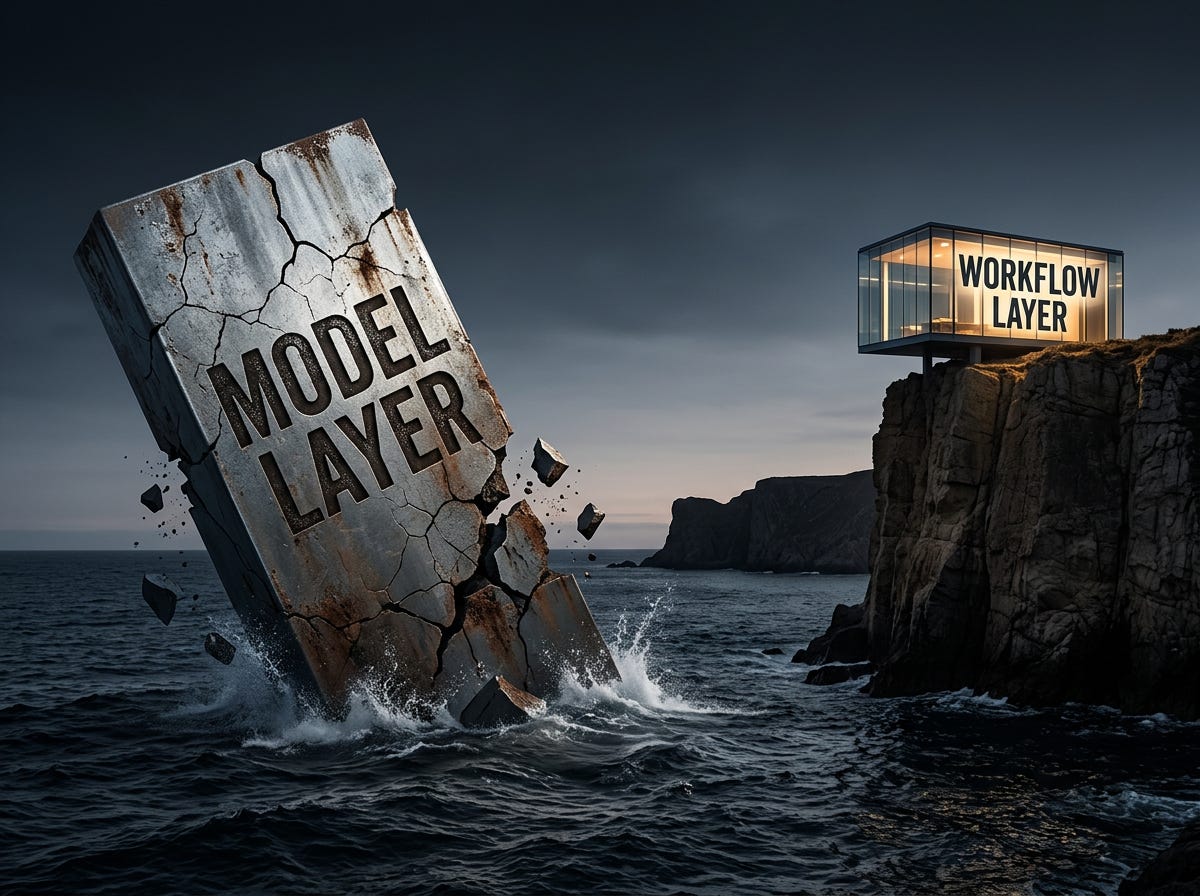
Anthropic moved from the commodity layer to the platform layer. Every company still in the model layer is now competing on price.
The enterprise confirmation followed quickly. Deloitte rolled out Claude to 470,000 employees in October 2025, establishing a Claude Center of Excellence and certifying 15,000 practitioners. Microsoft, which sells GitHub Copilot, began deploying Claude Code internally across its CoreAI, Windows, and Microsoft 365 divisions in January 2026. These are not model procurement decisions. They are workflow dependency decisions, the kind that take years to reverse, generate expanding contract values, and compound in the vendor’s favor with every quarter of deeper integration. The 500-plus enterprise customers now spending more than $1 million annually with Anthropic are not paying for intelligence. They are paying for intelligence packaged into a workflow they cannot easily rebuild elsewhere. That is a switching cost. The API layer never produced one.
Amodei told Dwarkesh he believes the API model is more durable than people think. There will always be demand from developers experimenting at the frontier, building on the latest capabilities before any product surface has caught up. He is probably right. But the revenue mix tells the actual story. The product layer, built in nine months, is out-compounding the substrate business built over five years. When your workflow layer outgrows your model layer within the same fiscal year, you have answered the question of where value accumulates. It was always going to be above the model.
The falsifiable prediction that follows directly from this mechanism: by 2027, no major AI company will derive a majority of its revenue from model access alone. The Moving Denominator will have compressed the remaining premium. The valuation logic of model labs, multiples built on the assumption that intelligence commands durable pricing power, collapses unless they own workflows. The market will reprice model labs as commodity suppliers unless they move up the stack. The next $10 billion AI company will not be a model lab. It will be the agent runtime that owns the layer where models get applied: where context is managed, scope is enforced, and output is made trustworthy enough to deploy in production systems with real consequences.
That layer is still mostly unbuilt. Which is the only reason the window is still open.
What to Do Before the Architecture Locks
For enterprise technology leaders and CTOs: the single most important question to bring into your next AI vendor review is not “which model is best.” It is this: what would it cost us to replace this vendor in eighteen months? If the answer is one afternoon of engineering time, you have a commodity contract regardless of what the relationship feels like. If the answer is six months of reintegration, retraining, and workflow reconstruction, you have a platform contract. Most organizations holding commodity contracts believe they have platform relationships. The distinction is invisible until you try to move. The Deloitte rollout, the Microsoft internal adoption, the 500-plus companies spending more than $1 million annually: those organizations understood the distinction and moved toward workflow dependency deliberately, before the architecture locked around someone else’s platform.
For founders building on AI: the trap is visible and still being walked into daily. I built a 300,000-line production platform over eight to ten months with Claude as the execution engine. The system held together not because the models were exceptional but because I built an explicit constraint layer around them: living architecture documents, invariant catalogues, surgical-change rules that prevented the model from touching anything outside defined scope. Without that structure, models drift. With it, they execute with precision. That constraint layer is what defensible vertical AI looks like: not a wrapper around a model, but the accumulated domain decisions, compliance requirements, and architectural invariants that make AI safe to deploy in a specific context at production scale. Cognition’s Devin completed 3 of 20 real-world tasks in Answer.AI’s January 2025 independent testing because the tasks required architectural continuity the substrate couldn’t provide. The general-purpose version of that constraint layer is being built by companies with nine-figure ARR. The vertical version, your domain, your constraints, your invariants, is still yours to own. Not for much longer.
For investors: Claude Code’s trajectory from zero to $2.5 billion in nine months is not a story about coding tools. It is the first large-scale empirical evidence that workflow ownership compounds in AI the same way distribution compounded in mobile and search. Model-only companies are structurally uninvestable. Not because the models aren’t good, but because value accumulates above them, in the workflow layer, where switching costs compound and margins survive. The signal is not benchmark rankings or capability demos. It is this: does the company’s revenue get stickier as it scales, or more substitutable? Does it own the workflow, or does it rent the customer from the platform that does? The valuation multiples of model labs are bets that intelligence commands durable pricing power. Haiku 4.5 at $1 per million tokens is the current price of that bet resolving against itself.
Anthropic didn’t escape the model layer. It proved that escaping it was the only path left.
The structural takeaway: 85% API-dependent in January 2025. $14 billion ARR by February 2026. A 10x-per-year revenue curve Dario Amodei himself described as “bizarre” on the record in February 2026: zero to $100M in 2023, $100M to $1B in 2024, $1B to $9-10B in 2025, several billion more added in January 2026 alone. Claude Code reached $2.5 billion in nine months, the fastest product revenue trajectory in enterprise software history, not because it was strategically designed to escape the model layer, but because an internal tool validated by internal usage accidentally proved that the workflow layer compounds faster than the substrate layer ever could. The model layer is a price war: Gemini Flash down 78%, DeepSeek at frontier quality for $5 million, Haiku 4.5 at $1 per million tokens. The workflow layer is where Deloitte’s 470,000 employees, Microsoft’s engineering divisions, and 500-plus million-dollar enterprise contracts are accumulating their switching costs. By 2027, no major AI company will derive a majority of revenue from model access alone.